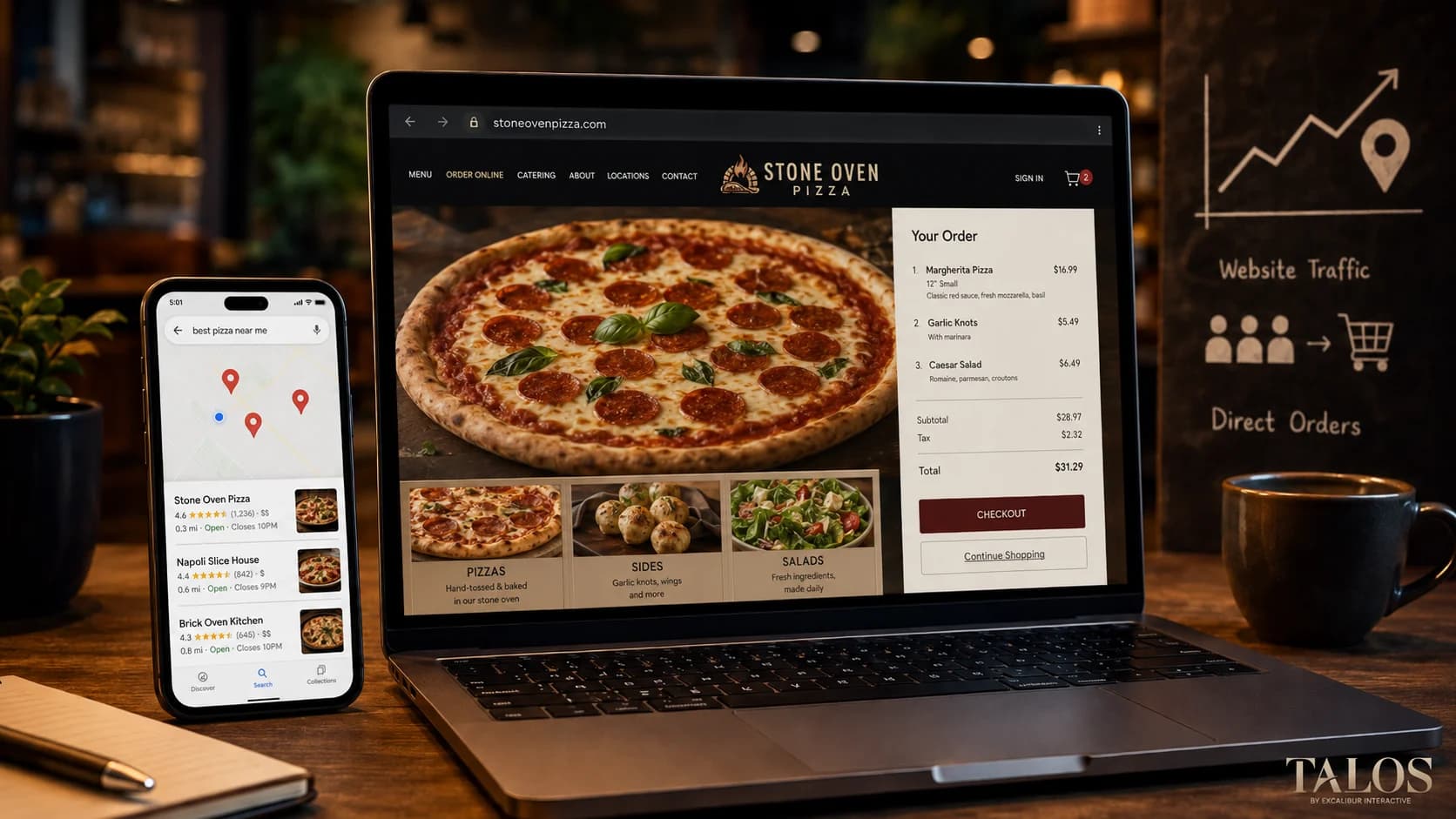
If you are trying to show up when someone searches "best [your cuisine] near me," you are not just competing with other restaurants.
You are competing with delivery apps, directories, and big listing sites that have entire teams dedicated to ranking.
That is why restaurant SEO is not a "nice to have." For most independent restaurants, it is the cheapest long-term way to drive orders without paying a commission on every sale.
But there is one mistake that quietly makes SEO harder than it needs to be.
You might be doing the work to get found, and then sending the order somewhere else.
Restaurant SEO is about earning local trust
Google is trying to answer one question: "Which result is the best match for this person right now?"
For restaurants, that comes down to a mix of:
relevance (are you actually what they searched for)
proximity (are you near them)
trust (do people click, engage, and come back)
The trust part is where most restaurants get stuck.
A site can look nice, but if it does not do much, it does not send strong signals. A page that acts like a brochure usually has short visits, low engagement, and very little reason for Google to rank it above a marketplace listing.
The hidden SEO problem: ordering lives somewhere else
A lot of restaurant websites work like this:
the homepage loads
the customer clicks "Order Online"
they get bounced to a completely different domain
From a customer perspective, it is already annoying. From an SEO perspective, it is worse.
When you link out to a separate ordering provider, you are giving away the strongest signals your business can generate:
high-intent traffic
menu browsing
add-to-cart behavior
checkouts
That activity should be happening on your domain. When it happens somewhere else, your website stays "thin" in Google's eyes.
You are basically telling Google, "This page is not where the real action happens."
Why on-domain ordering changes the math
When your menu, cart, and checkout live on your own website, customers can go from finding your restaurant to placing an order in one place.
Your website becomes a destination they can use, bookmark, and return to whenever they’re hungry.
That gives your SEO work somewhere useful to lead. Searchable menu pages help customers discover what you serve, and built-in ordering lets them act on that interest.
Over time, those pieces work together: your content can attract more customers through search, and your ordering experience can turn those visits into direct orders and repeat business.
Local SEO is not only content. It is structure.
Most owners assume SEO is just "write some content" or "post more photos."
That helps, but technical basics matter more than people think.
A strong restaurant site needs:
clean, canonical URLs (so Google is not splitting signals across duplicate pages)
structured data (schema markup) so Google can read your hours, address, and menu
fast pages (speed is a ranking factor, and slow sites lose customers)
real content (thin pages do not win)
Here is the issue: many drag-and-drop builders and bolt-on ordering links were not built with these fundamentals in mind. They were built to look decent on a template and get you "online."
Ranking is different.
What Talos does differently (and why it matters)
Talos builds restaurant websites with ordering built in, not tacked on.
That means your menu, cart, and checkout stay on your domain.
And because the goal is to rank, the technical foundation comes standard:
restaurant and menu schema (JSON-LD), so search engines can surface dishes, hours, and address
clean canonical URLs with no duplicates, so your authority is not split
server-rendered, fast menu pages Google can actually index
a local-search foundation (address and hours) built for "near me" results
In other words, the SEO work is built into the site instead of being sold as an add-on later.
The real goal: more orders without paying for every click
A lot of restaurant marketing is pay-to-play.
Ads, boosts, and promotions can work, but they stop the second you stop paying.
SEO is different.
If you can rank locally, you get a steady stream of high-intent customers searching for what you sell. And if ordering happens on your site, those customers turn into direct revenue instead of another marketplace commission.
That is why restaurant SEO and direct ordering should be treated as one strategy, not two separate projects.
A quick self-check for your site
If you want to sanity-check whether your current setup is helping or hurting, ask:
When a customer clicks "Order Online," do they stay on my domain?
Do my menu pages load fast on a phone?
Does my site clearly show address and hours?
Is my menu readable by Google, or is it just an image / PDF?
If the ordering experience lives off-domain, you are probably losing more than you think.
Not just commissions, but the long-term SEO equity that could have reduced your dependence on paid channels.
Build the site that earns the authority
Restaurant SEO is a long game. The restaurants that win it usually do not win because they posted a few extra photos.
They win because their website is built to be the place where customers actually order.
Talos builds SEO-optimized restaurant sites with ordering built in, so your domain earns the authority and your direct orders grow organically.
If you want to see what that looks like, reach out and we will show you what it can do!